Structured, evidence-based literacy instruction for students with dyslexia and reading difficulties.
Question & Answer Blog
I am an Accredited Associate of the Orton-Gillingham Academy.
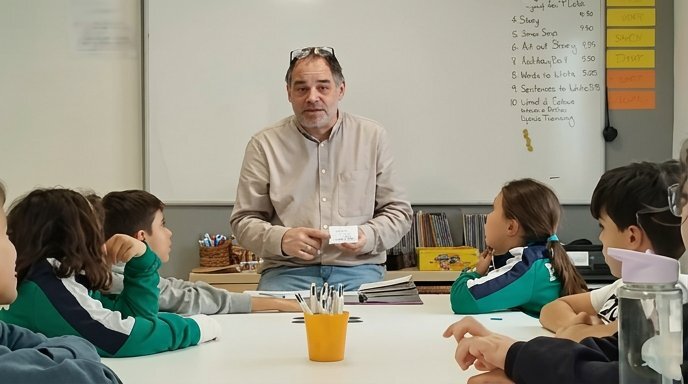
Since 2011, I have owned and run English Unplugged in Jaén, Spain, an after-school English program using Structured Literacy to help students become bilingual. In 2021, I discovered the Orton-Gillingham approach and began working with students with dyslexia. While training, I began to recognize my own experiences in many of my students' challenges, so I took the IDA adult dyslexia screener. The results indicated I am at high risk of having dyslexia.
This helped me better understand my own experience growing up in Chicago, where I worked hard to become a confident reader at a time when dyslexia was little understood, was taboo, and often went undiagnosed.
That journey shapes how I teach today, whether working with my native English speaking or my ESL students. It is not just about using the right method, it is also about being able to use my own experiences to help students feel capable, supported, and confident that they can succeed.
Dyslexia is a specific learning difficulty that affects reading and spelling. It is neurological in origin — not a reflection of intelligence, effort, or character. It is one of the most common learning differences in the world.
Understanding the nature of dyslexia is the first step toward meaningful progress. Many students struggle for years without a clear explanation of why reading feels so hard.
"Dyslexia is an unexpected difficulty in reading in an individual who has the intelligence to be a much better reader." — Sally Shaywitz, M.D., Overcoming Dyslexia
In alphabetic writing systems, each symbol (grapheme) represents a sound (phoneme). Reading requires phonological decoding — breaking words into their sound components and blending them back together. Dyslexia in alphabetic languages primarily shows as a weakness in this phonological processing: difficulty hearing the distinct sounds within words, matching them to their letters, and retrieving them quickly and accurately.
This is why structured, phonics-based approaches like Orton-Gillingham are so effective — they directly target the underlying phonological deficit with explicit, systematic instruction.
In logographic writing systems like Traditional Chinese characters, each character encodes a morpheme — a unit of meaning — rather than a single sound. A fluent reader must recognise thousands of visually complex characters by their overall form, component radicals, and stroke sequence.
Dyslexia in this context often manifests as difficulty memorising character forms, confusing visually similar characters, and struggling with stroke order. While phonological awareness still plays a role — characters carry tonal pronunciation — the visual-orthographic demand is far greater than in alphabetic systems.
This confirms that dyslexia is neurological and universal. It is not caused by the language, but its expression is shaped by the writing system the reader must learn.
The Orton-Gillingham approach is the most researched and widely used method for teaching students with dyslexia. It is explicit, systematic, sequential, and multisensory.
Developed in the 1930s by neurologist Dr. Samuel Orton and educator Anna Gillingham, the approach grew from Orton's clinical observation that students with reading difficulties shared common neurological patterns. Gillingham systematised his insights into a teachable method, first published in 1935. Nearly a century of research has validated and continued to refine what they began.
Visual, auditory, and kinesthetic pathways are engaged simultaneously to build stronger memory traces.
Skills are introduced in a logical order, each building on what came before. Nothing is left to chance.
Patterns in language are taught directly — no guessing, no inferring. The student always knows what they are learning and why.
Each session is planned around the student's specific needs. Progress is tracked and the plan adjusts accordingly.
Every student is different. Sessions are shaped around the individual — their current level, their pace, and what they need to move forward. There is no fixed script, only a systematic approach applied with care.
Get in TouchOne-to-one sessions are available online for students anywhere in the world, and in person in Jaén, Spain. Each session is built entirely around a single student — their current level, their pace, and what they need next. In-person sessions allow for the full range of multisensory OG techniques, including hands-on materials and tactile practice. Online sessions are fully adapted to work via video call — structured, interactive, and no less attentive.
Small group sessions bring together students at a similar level. Working alongside peers builds shared language around reading and lets students see that they are not alone in their experience. Groups are kept small so that every student still receives close attention. Available in Jaén, Spain.
A structured assessment to map the student's current reading profile, identify specific areas of difficulty, and design a personalised programme from the outset.
Parents are kept informed and involved throughout the process. Understanding the approach helps families reinforce progress and support their child with confidence at home.
Dedicated time to discuss how the student is progressing, answer questions, address concerns, and plan the next phase of work together.
Written records of the student's development shared at regular intervals — so that progress is visible, documented, and can be shared with schools or other professionals if needed.
Testimonials from students and families coming soon.
Content to be addedStudent progress stories and parent feedback will appear here.
A step-by-step guide to getting started with tutoring coming soon.
Content to be addedHow to get in touch, what the first session looks like, and what to expect from the process will be explained here.